Which descender is rated for two people? ISC's D4, and the version that removes the safety feature
The ISC D4 is rated to 240 kg with two people on it. Its sibling, the D4PRO, is the same device with the panic brake deleted — and professionals buy it on purpose. Here's what each certification actually covers.
Most descenders are rated for one person. Put a rescuer and a subject on the same device and you’re outside the working range the manufacturer tested, which is a bad place to discover the difference between a rating and a hope.
ISC Wales builds the D4 the other way round. Two people is the design case, not the exception.
What load is the ISC D4 rated for?
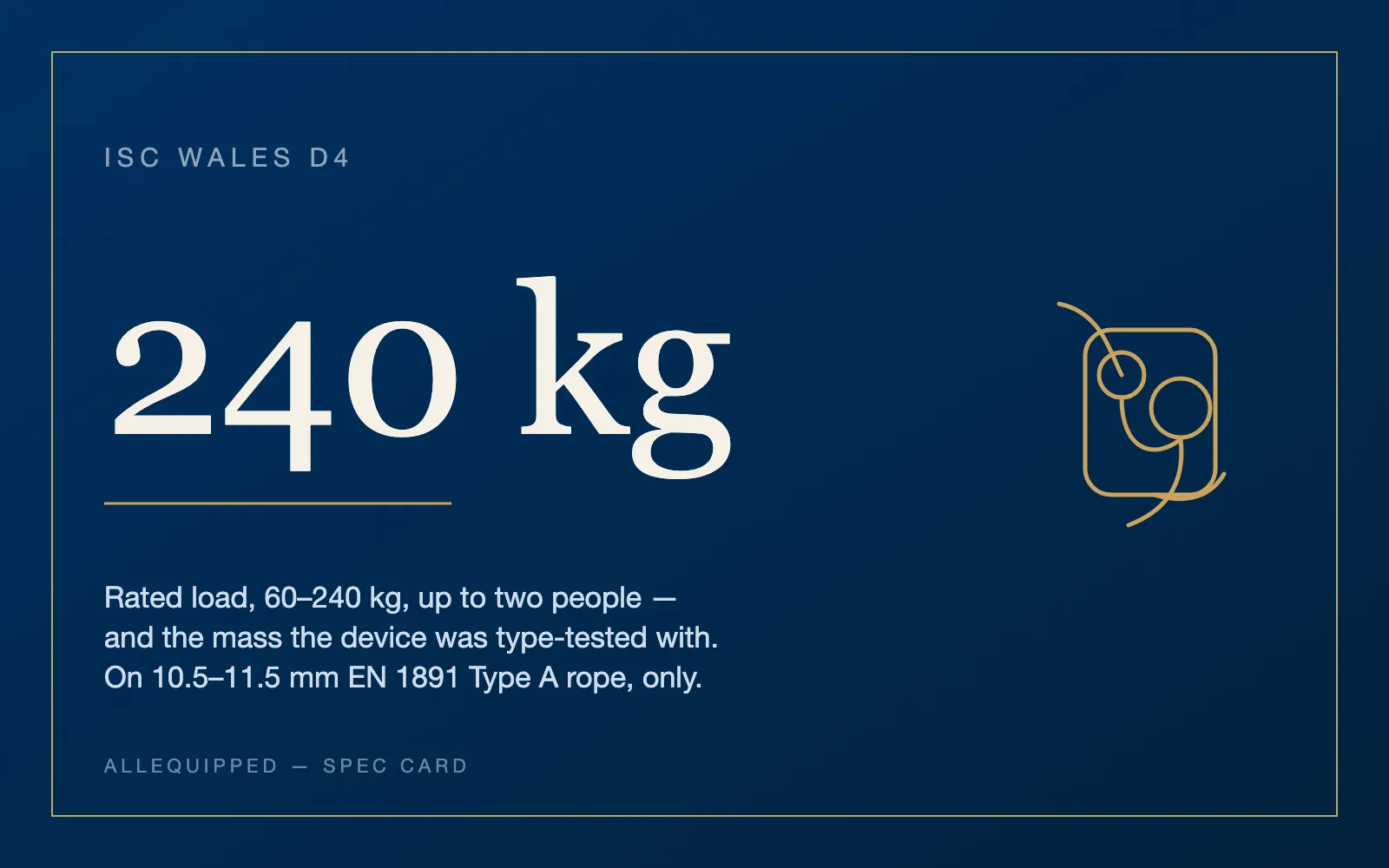
240 kg (529 lb), for up to two people, with a minimum rated load of 60 kg. That figure isn’t a calculated headroom number — the D4 datasheet gives it as the rated load, and the user manual states the certification testing “was carried out by SATRA Technology Centre (AB0321) and was performed using a 240kg test mass.”
The device marking reads Max220m(60-240kg). Note what that is: one continuous rated band, not a single-person rating with a separate two-person rating bolted above it. The whole 60–240 kg range is the normal operating envelope.
The minimum matters as much as the maximum. Below 60 kg the device isn’t guaranteed to behave the way it was tested either — a light technician on a D4 is as far outside the envelope as an overloaded one.
What rope does it take, and how far will it go?
10.5 to 11.5 mm, EN 1891:1998 Type A rope only, to a maximum descent of 220 m.
The rope specification is written into the device marking, not buried in a compatibility appendix: Ø10.5-11.5mm EN 1891:1998-A Rope, Only. This is the same species of constraint as the rating split on the CMC MPD — the certification belongs to a device-plus-rope configuration, and swapping the rope for something outside the band takes you outside the certification with it.
Other published figures, all from ISC:
| Spec | D4 (RP880) | D4PRO (RP881) |
|---|---|---|
| Rated load | 240 kg / 529 lb | 240 kg / 529 lb |
| Persons | 2 | 2 |
| Rope | 10.5–11.5 mm | 10.5–11.5 mm |
| Weight | 678 g | 676 g |
| MBS | 16 kN | 16 kN |
| Slip load | 5 kN | 5 kN |
| Panic brake | Yes | No |
| ANSI Z359.4:2013 | Yes | No |
Operating temperature is −30 °C to 50 °C. It’s a heavy device by rope access standards, and ISC’s own launch material is unapologetic about why — testers quoted in the D4 launch feature said the burly metal construction made competing products “feel like a flimsy toy.”
What does the panic brake actually do?
Let go of the handle and it locks; pull the handle too far and it also locks. That’s what “double-stop” means — a stop at each end of handle travel, with the controlled descent range in between.
ISC describes it as “a double-stop device with an auto-lock function (which is activated whenever the operator lets go of the handle) and a panic brake which is not overly sensitive in normal use.” The mechanism is a progressive cam design — one cam operating inside another — and the manual’s inspection instruction gives away how it works: “when the handle reaches PANIC the cam must snap forwards in the direction of applied pressure.”
One detail worth knowing before you rely on it: the manual states that “the PANIC function will be harder to engage if the braking side of rope is held firmly.” A death grip on the brake line works against the feature that’s supposed to save you.
Why would anyone buy the D4PRO, which has no panic brake?
Because on a long descent the panic brake is the thing that keeps interrupting you. ISC’s own description is flat about it: “The D4PRO Descender is the same great Work/Rescue Descender, but without the panic brake.”
That sounds like a downgrade and mostly it isn’t marketed as one. The PRO came out of feedback from professional rope access and rescue users who wanted a wider usable speed range — what ISC calls a bigger “sweet spot” — without the top end of handle travel triggering a stop. The manual is blunt about the trade: “The user must descend at a suitable speed.”
It keeps the auto-lock. Release the handle and it still locks. What it loses is only the over-pull stop.
The consequence you can’t argue with is on the label. The D4PRO is not ANSI certified, because a panic function is mandatory under ANSI Z359.4. The D4 carries ANSI Z359.4:2013; the PRO carries EN 12841 and NFPA, where it isn’t required. If your jurisdiction or your client specification says ANSI, the PRO is off the table regardless of how it feels to descend on.
UK reseller Gustharts states the same thing independently: the D4PRO “does not incorporate a panic-brake” and therefore “cannot fully meet ANSI standards.”
Which standards does the D4 actually carry?
Verbatim from the device marking, which is the authoritative version:
- EN 12841:2024 — Type C. Working line descender. Not Type A (backup), not Type B (ascender). IRATA’s write-up of the standard is a clean explanation of the three types, and BSI lists the 2024 edition as current.
- NFPA 2500 (1983) 2022 ed., “T” — Technical use, MBS 16 kN. The dual 2500/1983 marking is the transition labeling we covered in the standards piece.
- ANSI Z359.4:2013 — D4 only.
- Patent GB2522179; notified body numbers 0120 and 0598.
Is the ISC D4 certified to EN 341?
No — and ISC published a document specifically to stop people saying it is. Several resellers list EN 341 in the D4’s certification block. ISC’s own statement says: “This in no way implies that the D4 is approved according to EN341:2011.”
Their explanation is procedural rather than performance-related — EN 341:2011 has no Annex ZA and isn’t harmonized for PPE purposes, so no EN 341 certificate can be issued against it for a device in this category. The D4’s descent-device credentials live in EN 12841, ANSI Z359.4 and NFPA.
This is worth flagging because it’s the kind of error that survives. A reseller’s spec table gets copied into a procurement document, which gets copied into a method statement, and eventually someone is auditing against a certification that was never issued.
Anything else to check before you buy one?
Two things.
Which generation you’re looking at. In January 2016 ISC made a running change: a longer forged, hard-anodized aluminum handle, the handle position rotated 30°, and a harder-grade stainless top bobbin. Units in service predate it. Nothing about that makes older ones unserviceable — it’s the same situation as the ASAP’s generations, where knowing which one is in the bag is part of maintaining the register.
How you inspect it. ISC published a wear-indicator guide for the D4 and D5 showing where to look and when to retire. Metal devices have no expiry date, so condition is the whole answer — the same argument that makes carabiner wear worth a post of its own.
The short version
If your rescue plan involves picking someone off a rope, the question isn’t whether a descender can take two people. It’s whether it was tested with two people on it. The D4 was, at 240 kg, on 10.5–11.5 mm EN 1891 Type A rope, and nothing else.
And if someone hands you a D4PRO, check the job specification before you check the handle. It’s the better device to descend on and the wrong device to hand an ANSI auditor.
Full write-up on the manufacturer is on the ISC Wales brand page. We use and recommend ISC; nobody paid for this, and when they become a stockist we’ll say so on the page.