Five flagships, one number each
Five brands we rate, the product each is known for, and the single specification that explains why. If you only remember one number per device, make it these.

Every manufacturer has one product that people mean when they say the brand’s name. Ask a rope tech about ISC and you’ll hear about a descender. Say Sterling in a rescue cache and someone thinks of a rope, not a company.
We’ve done deep dives on several flagships already — CMC’s MPD, Edelrid’s Bulletproof, Teufelberger’s treeMOTION, Rock Exotica’s Omni-Block, Petzl’s ASAP. This one covers five more brands at a different altitude: the flagship, and the one number on its spec sheet that tells you what the product is actually for.
A note on the pictures: these are our own spec cards, not product photography. The manufacturers own their photos; the numbers are the part that matters anyway.
ISC Wales — the D4 descender
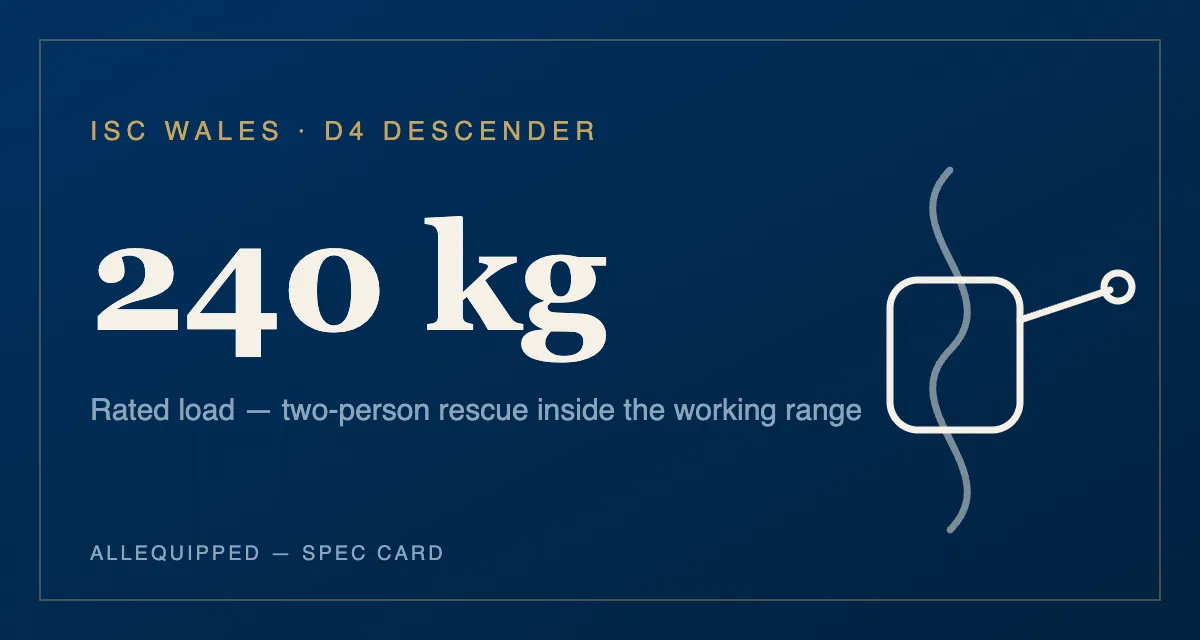
The number is 240 kg (529 lb), and it changes what the word “rescue” means in a work plan.
Most descenders are certified around a single technician. The D4 is rated for 240 kg on 10.5–11.5 mm rope at 676 g, certified to EN 12841 and NFPA 1983 — which puts a technician plus a casualty inside the device’s normal working range, not at the edge of it. If your rescue plan involves picking someone off a rope, the lowering that follows is the whole job, and this is the device built for that moment.
One nuance worth knowing before you buy: the standard D4 runs a double-stop with a panic brake — grab it in fright and it locks. The D4 Pro deliberately omits the panic function for experienced users doing long descents, and as a result it doesn’t meet the ANSI criteria, though it keeps full EN 12841. Same body, different philosophy — the configuration is the certification, again.
Skylotec — the MILAN 2.0
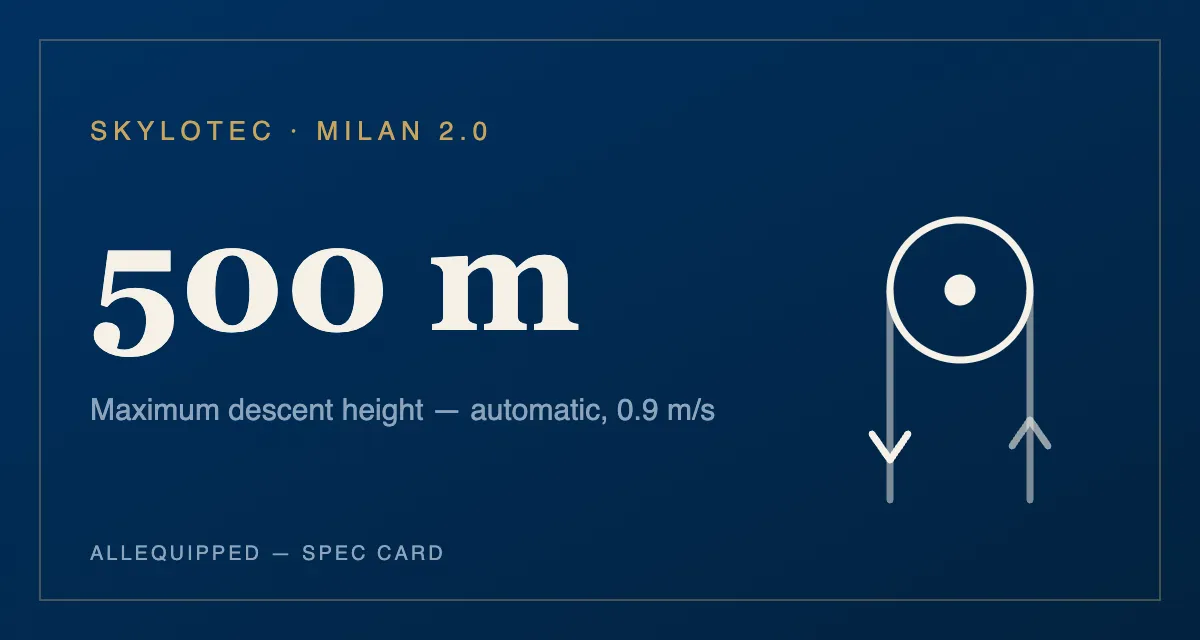
The number is 500 m of descent, and the point is who’s in control during it: nobody, by design.
The MILAN 2.0 is an evacuation device. A centrifugal brake holds descent at a constant 0.9 m/s with no input from the person on the line — because the person on the line may be unconscious, panicking, or simply not a rope technician. Rated 260 kg, up to two people, certified EN 341-A and ANSI Z359.4, with a lifting function for getting a casualty off their attachment before the descent starts, at about 4.3 kg for the device.
This is the machine wind-turbine and tower crews build their rescue plan around, and it’s the clearest example on this page of a flagship defining a brand: Skylotec’s whole identity — the company that engineers the escape route into the structure — is this device in miniature.
Sterling — HTP Static
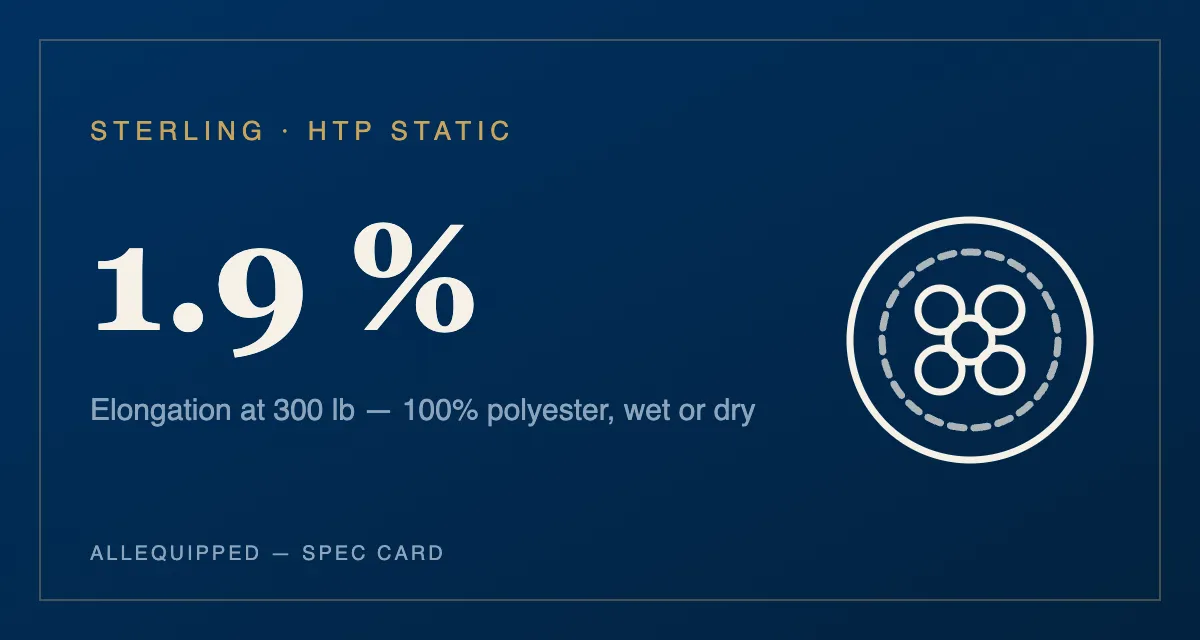
The number is 1.9% elongation at 300 lb, and the material is why it holds.
The HTP was the first 100% polyester static rope, and polyester barely absorbs water. Nylon rope wet is a different rope — it shrinks, stiffens, and loses strength. Polyester in the rain is very nearly polyester in the sun, which for a rescue team that doesn’t get to choose its weather is not a detail. The 11 mm runs 30.5 kN MBS at about 6.5 lb per 100 ft, NFPA 1983 certified, with a sheath tight enough that ascenders bite cleanly.
Low stretch is the working consequence. Haul systems waste less effort loading the rope, long ascents don’t bounce — the rope moves when the load moves, which is the entire request anyone makes of a static line.
CAMP Safety — the Goblin
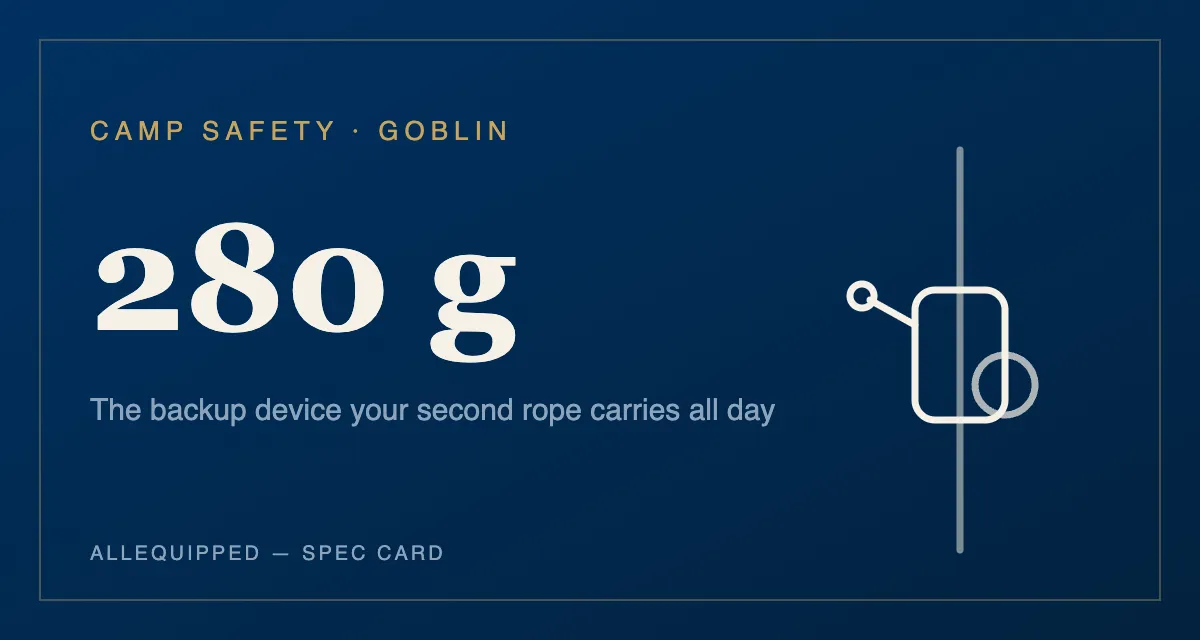
The number is 280 g, and it matters because of what we said about backup devices: they do nothing all day. Weight you carry for a device that works for one second in its whole life is weight you feel differently.
The Goblin runs on 10–11 mm rope, certified EN 12841 type A and EN 353-2, rated 120 kg for a single user and 200 kg in its rescue configuration. It tracks the rope smoothly in both directions, locks even if it’s grabbed mid-fall — the panic case that defeats some simpler devices — and can be deliberately blocked when you want it parked.
Rope access technicians who’ve cycled through everything tend to land on it quietly. There’s no single dramatic feature; there’s a device that weighs little, doesn’t argue with the rope, and does the one thing it exists for without fuss. Some flagships are famous. This one is chosen.
DMM — the Rhino
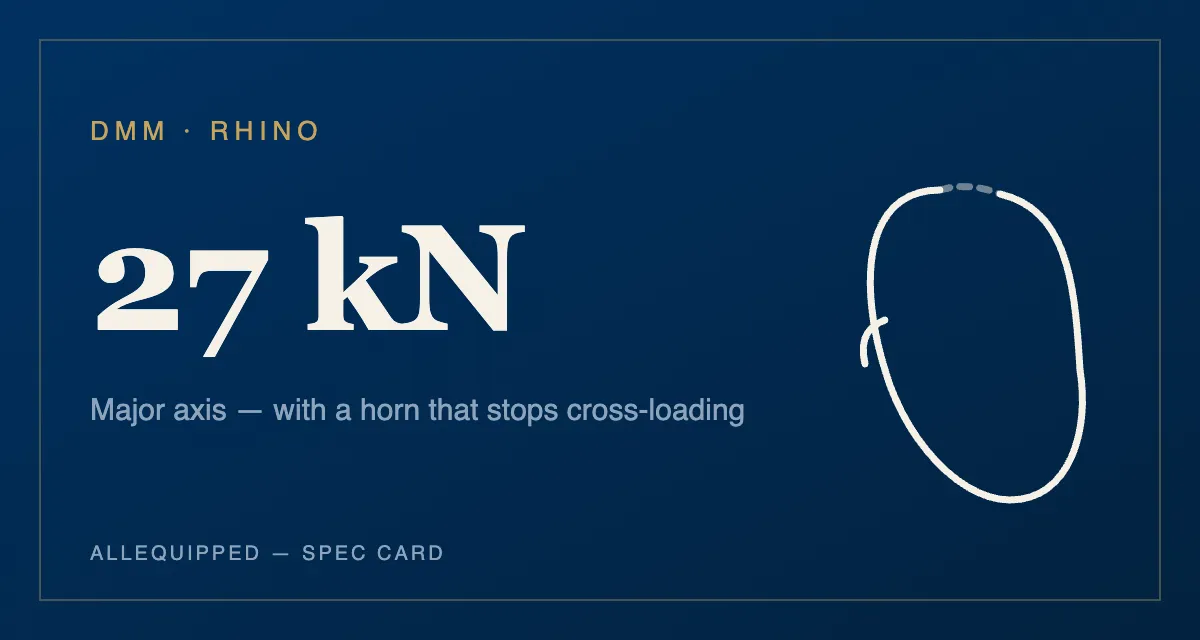
The number is 27 kN on the major axis — but the reason the Rhino exists is the small horn on its spine.
A carabiner’s strength assumes it’s loaded end to end. Let a belay device or pulley rotate around the frame and load it across the gate, and you’re on the 9 kN minor-axis figure instead — a third of the strength, from nothing more than the hardware shifting while you weren’t looking. DMM’s answer is mechanical, not procedural: the horn physically restricts devices from rotating out of position. In DMM’s words, it “significantly reduces the possibility of cross loading with rigging, belay & rope devices, and pulleys.”
73 g in screwgate, 20 mm gate, certified EN 362:2004 B and EN 12275:2013 B/H, hot-forged in Llanberis like everything DMM makes. It’s the same lesson the wear post ended on: the connector is the cheapest component in the system and the one doing the most safety-critical geometry. Buying the version that maintains its own geometry is the rare upgrade that removes a human task instead of adding one.
The pattern, if there is one
Five numbers: 240 kg, 500 m, 1.9%, 280 g, 27 kN. A load, a distance, a stretch, a weight, a strength.
None of them is the biggest number in its category, and that’s the point. Each is the number the product was designed around — the requirement the rest of the device serves. When you’re comparing gear, finding that number tells you more than the whole rest of the table: it tells you what problem the manufacturer thought they were solving.
The full write-ups on all five manufacturers — ISC Wales, Skylotec, Sterling Rope, CAMP Safety, DMM — live on Brands We Love. We use and recommend all five; nobody paid for this, and when any of them becomes a stockist we’ll say so on the page.