The only life jacket with an expiry date: inflatable PFDs, and who tells you when they fail
An inflatable PFD is the one piece of life-saving equipment aboard with consumable parts. It also sits outside the CPSC's jurisdiction, so there is no public recall database — which makes a manufacturer's own advisory archive the only systematic record that exists.
Every other piece of safety equipment on a boat either works or is visibly broken. An inflatable life jacket can look perfect, feel perfect, pass a glance, and still not inflate — because the part that does the work is a consumable with a date on it.
Still deciding whether to buy an inflatable at all? Start with the guide: should you buy a foam or an inflatable life jacket? This piece assumes you’ve chosen one and covers what owning it costs you.
How does an inflatable PFD actually inflate?
A spring-loaded pin punctures a CO2 cylinder, and the trigger for that pin is the whole design question. There are three ways it fires: automatically, by pulling a handle, or by blowing into the oral tube.
The automatic trigger comes in two kinds, and they behave completely differently.
A bobbin (or pill) is a water-soluble element. It gets wet, it dissolves, the spring releases, the cylinder is punctured. Simple, cheap, and it cannot distinguish between the sea and a rainstorm.
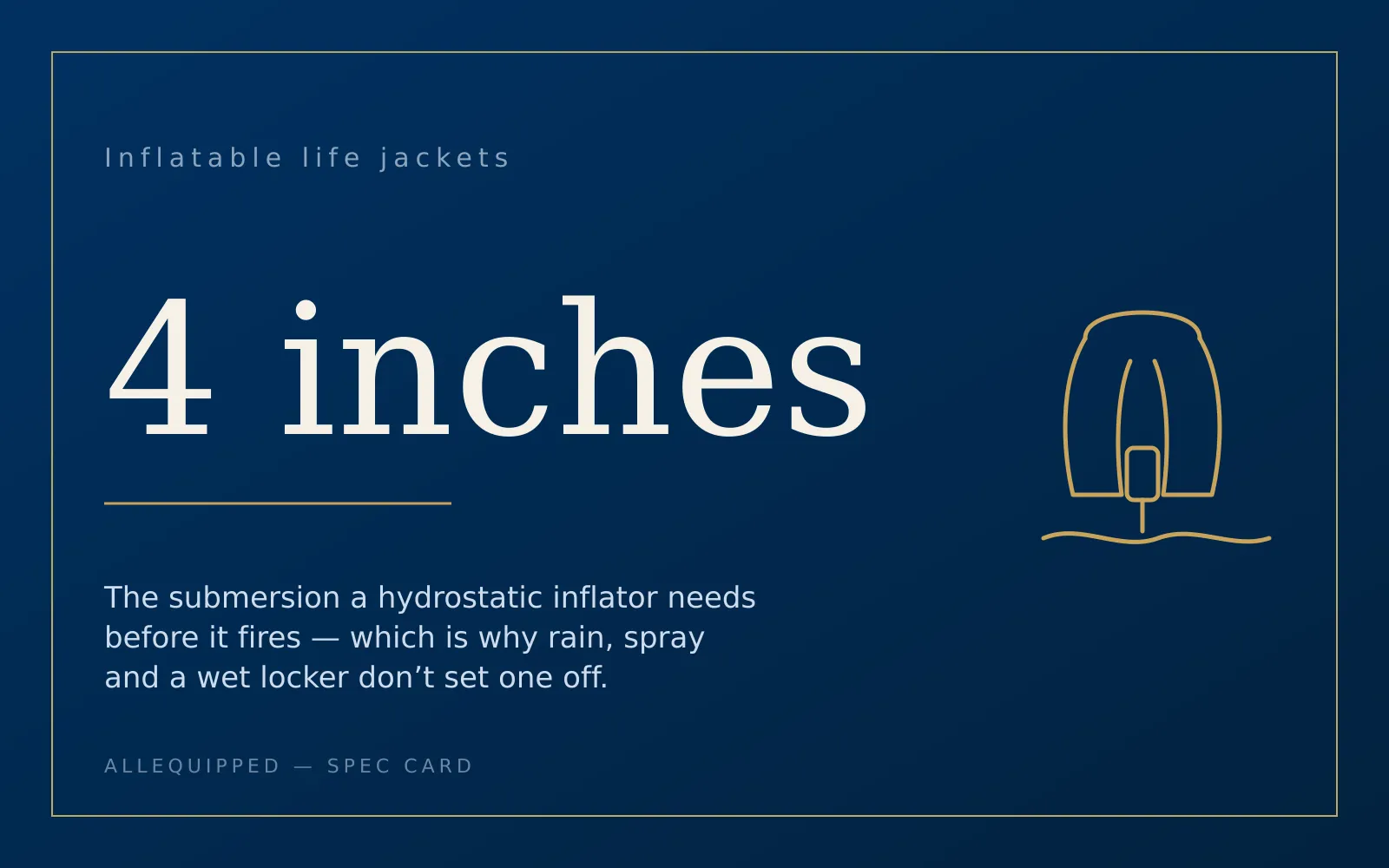
A hydrostatic inflator waits for pressure. Mustang Survival’s description of the Hammar mechanism is that submersion creates a pressure differential — trapped air rises to the top of the bladder while the inflator sits lower — which opens a hydrostatic valve, admits water to a water-sensitive element, and releases the spring. The published threshold is a pressure difference exceeding ten centimeters, about four inches. Below that depth it does nothing, and you inflate manually.
Mustang states the consequence directly: hydrostatic units “activate only when fully submerged, preventing accidental inflation from rain, humidity, or spray.”
Bobbin or hydrostatic — which should you buy?
Hydrostatic, if the jacket lives on a boat and gets rained on. Bobbin is fine if it lives dry and you service it.
The trade is service interval against price. Mustang describes the hydrostatic inflator as requiring “no maintenance during its operational period” — you “just replace the inflator after the five-year expiry date or when the single-point indicator is red.” Bobbins are shorter-lived and less patient: Mustang’s maintenance guidance says to replace when the current year exceeds the manufacture year by two or more, one Mustang manual says three years, and Stearns says “replace the Bobbin every 3 years or more often if the unit gets wet or is used in hot, humid or foggy conditions.”
So roughly: five years hands-off, or two to three years as a consumable. The honest caveat is that even one manufacturer’s own documents don’t agree on the bobbin number — see below, because that turns out to be the theme.
How often are you supposed to inspect one?
Nobody agrees, including within a single brand. Across four Mustang documents we found four different intervals for the same task:
| Source | Leak test / inspection interval |
|---|---|
| Mustang maintenance guide | Leak test and inflator check every 6 months |
| Mustang MD3183/MD3184 manual | Leak test every two months |
| Mustang MD3188 manual | Thorough inspection every 3 months |
| Mustang DLX 38 manual | Leak test every 6 months |
| Stearns/Sospenders | Season start, then every two months |
The leak test itself is inconsistent the same way: orally inflate until firm and leave it 16 hours (MD3183, MD3188), or 2 hours (DLX 38), or “at least two hours, ideally overnight (16 hours)” (the maintenance guide). If it isn’t still firm at the end, the bladder is done.
None of these are wrong exactly — different products, different vintages. But if you own two inflatables from the same company you are being given two different schedules, and the practical answer is to take the shortest one that applies and put it in a calendar. Every two months, orally inflate it overnight. That single habit catches the failure mode that no visual inspection will.
What condemns a CO2 cylinder?
Weight, and the standard is “matches what’s stamped on it.”
The cleanest published procedure is Stearns’: weigh the cylinder on a scale, “compare the weight printed on the cylinder to the actual weight. If they do not match, get another cylinder.” A cylinder that has quietly bled down weighs less than its stamp, and there is no way to tell by looking.
Worth being precise about what isn’t published: no manufacturer we found publishes a gram-loss tolerance. There is no “replace if more than 2 g light.” The rule is match the stamp or replace. Mustang’s own documents cover corrosion and threading but publish no weighing procedure at all.
Check the threading too. Corrosion at the neck is the common finding, and it is a replace, not a clean.
Why must a rearm kit match the exact model?
Because cylinder sizes and threads differ, and the wrong one gives you a jacket that looks armed and isn’t.
The clearest warnings come from the inflator manufacturer and from Stearns rather than from the jacket brands. Halkey-Roberts: “Use only the rearming kit stipulated above for use with your PFD. Rearming kits and parts are not interchangeable.” Stearns names the mechanism: “World Class models use a 38 gram CO2 cylinder with 1/2 inch threading. The Sport model uses a 24 gram CO2 cylinder with 1/2 inch threading… These cylinders are not interchangeable, and use of the wrong CO2 will damage your PFD or fail to inflate it properly.”
Real sizes in circulation across brands: 16 g, 24 g, 33 g, 38 g. Onyx names its kits after the arming style and the gram weight — M-16, M-24, A/M-24, A-33 — which is the most legible convention in the category.
This is the same shape as the ASAP and its energy absorber: the certified product is a combination, and the failure mode is somebody grabbing a spare from the shelf because it physically fits.
Does an inflatable count if it’s stowed in a locker?
No. It has to be worn. The regulation route is 33 CFR 175.15, which requires each PFD be used “in accordance with any requirements on the approval label” and in accordance with the owner’s manual where the label references one — and it’s the label that carries the wear requirement.
Mustang’s manuals state it flatly: the jacket “must be worn before getting underway and whenever above deck and not within an enclosed space to meet the carriage requirement.”
A related labeling change worth knowing, because retail copy hasn’t caught up. The Type I–V codes were removed from the regulations in 2014 (final rule, 22 September 2014), replaced by “wearable” and “throwable.” Then the Lifejacket Approval Harmonization final rule, effective 6 January 2025, moved new approvals to buoyancy Levels — 50, 70, 100 — with pictorial markings. Existing devices under the legacy series “may continue to be manufactured, sold, and used to meet carriage requirements.”
So “Type V” is not current terminology, it is a legacy label you will still see on perfectly legal equipment for years. If a retailer’s page says Type V and the jacket’s own label says Level 70, the label is the newer one.
Who tells you when a life jacket has a defect?
The manufacturer, because for recreational PFDs there is nobody else.
This is the structural fact underneath the whole subject, and it is checkable. The CPSC’s own list of products outside its jurisdiction names “Boats and boating equipment” and “Personal flotation devices (life jackets),” pointing to the Coast Guard. The one carve-out is that CPSC “may share jurisdiction over life jackets intended for use by children.”
The Coast Guard runs no public recall database equivalent to CPSC’s. It issues Marine Safety Alerts case by case — there is one from 2011 for Mustang MD2010/MD2012 inflatables with an inflator installation inconsistency — but there is no searchable index a buyer can check before purchase.
Which means a manufacturer’s own advisory archive isn’t a courtesy. It is the only systematic public record that exists.
Mustang publishes one, openly, going back to 2011. Two entries are worth reading as a pair:
The 2024 advisory concerns the Halkey-Roberts V96000 manual inflator on the MD4041 MIT 70 and MD3800 Essentialist Belt Pack. The fault is not a failure to inflate — it’s that “when removing a full CO2 cylinder from an unfired manual 3F inflator, the indicator status can remain green or partially green/red.” The jacket still works. The green window that tells you it’s ready can lie. The remedy is a five-step owner reset. That’s a subtle, easily-buried problem, and they published it.
The 2025 recall is the harder one: MD3196 and MD3196SO Compact Tactical models, a manufacturing issue in HAMMAR automatic hydrostatic cylinder assemblies “inhibiting on the ability for the PFD’s/LPU’s to perform and leading to a non-inflate.” The instruction was to discontinue use pending inspection. That is a genuine non-inflate on a product whose entire job is to inflate, and it was published by the company that made it.
For contrast, look at what happens when a product is a consumer good. When Black Diamond recalled the PIEPS DSP avalanche transceivers in April 2021, it went through CPSC as recall 21-108 — roughly 66,100 units in the US and 12,500 in Canada, 65 reports of unexpected mode switching, one death and one serious injury. Public, indexed, searchable, with numbers.
No such record can exist for a life jacket. So the question “does this company publish its own problems?” is not a nice-to-have when you’re choosing a brand. It is the only signal available.
What should you actually do?
Five things, none of which take long.
Diary a two-month oral inflation test. Blow it up, leave it overnight, check it’s still firm. This is the test that finds a dead bladder before the water does.
Read the window every time you put it on. Green means armed. After the 2024 advisory, treat green on a manual inflator you’ve recently rearmed as worth a second look, not gospel.
Weigh the cylinder against its stamp at the annual check, and look at the threads for corrosion.
Buy the rearm kit by model number, not by gram size that looks right.
Register the product and read the manufacturer’s advisory page once a season. Nothing else will tell you.
And on belt packs specifically: Onyx’s own product page for the M-16 says it “requires secondary donning” — 17 lb of buoyancy from the 16 g charge, up to 26.5 lb with the oral tube, but you have to fire it and then pull the horseshoe over your head. That’s a real limitation stated plainly by the manufacturer, and it is the reason a belt pack is a compromise for a strong swimmer rather than a default for everyone aboard.
One gap worth naming: Onyx does not publish buoyancy, cylinder size or approval level on its own A/M-24 product pages, though third-party listings carry a Level 70 rating. For a flagship inflatable, that’s thin.
Full write-ups on the manufacturers are on the Mustang Survival and Onyx Outdoor brand pages. We use and recommend both; nobody paid for this, and when they become stockists we’ll say so on the page. Always follow your own product’s manual over anything written here.